Centre for Studies in Karbi Language and Culture (CSKLC)
The Centre for Studies in Karbi Language and Culture (CSKLC), Situated at Rongkimi, Lumding Road, Diphu, is a premier academic institution dedicated to the preservation, documentation, promotion, and advancement of the Karbi language, indigenous literature, and cultural heritage. The Centre was established in response to UNESCO’s classification of the Karbi language as a "Vulnerable" language in its Atlas of the World's Languages in Danger, emphasizing the urgent need for academic and community-based language revitalization.
Institutional Framework and Milestones
CSKLC was established in 2018 as a self-financed initiative of the Society for Promotion of Karbi Language (SPKL). SPKL is a non-profit organization registered under the Registration of Societies Act XXI of 1860 and is led by a dedicated group of academicians, cultural leaders, professionals, and language advocates committed to the advancement of Karbi language and culture.
The Centre serves as the Diphu Centre of the Centre for Studies in Languages, Dibrugarh University, one of Northeast India's leading state universities. Functioning as a specialized academic extension of Dibrugarh University in Karbi Anglong, CSKLC has been formally recognized by the Karbi Anglong Autonomous Council (KAAC) and serves as a crucial bridge between community-based language preservation efforts and structured higher education.
Since its establishment, CSKLC has achieved several important milestones:
* Successfully conducting the Dibrugarh University Certificate Course in Karbi since 2018.
* Providing regular academic instruction and examinations for more than fifteen student batches.
* Collaborating with prominent regional institutions, including the Anundoram Borooah Institute of Language, Art and Culture (ABILAC), Assam.
* Promoting academic research, language standardization, and cultural documentation across the Karbi-speaking community.
Vision and Mission:
CSKLC envisions a future where the Karbi language remains academically strong, culturally vibrant, and fully equipped for contemporary communication, literature, education, and digital engagement while preserving its rich oral traditions and indigenous knowledge systems.
The Centre is committed to:
* Preserving and promoting the Karbi language and literature.
* Supporting higher education and teacher training in Karbi studies.
* Encouraging scholarly research and publication.
* Documenting and safeguarding traditional knowledge and cultural heritage.
* Developing modern linguistic resources for future generations.
Core Academic Pillars:
1. Teacher Training and Higher Education
Through the Dibrugarh University Certificate Course in Karbi and other language-training initiatives, CSKLC contributes to the development of qualified language educators and scholars. The curriculum emphasizes grammar, phonetics, literary traditions, language pedagogy, and contemporary teaching methodologies, ensuring the effective integration of Karbi language studies into primary, secondary, and higher education.
2. Research and Publishing
CSKLC functions as an active research and publishing hub dedicated to indigenous knowledge and linguistic development. Its activities include:
Terminology Development: Creating and standardizing modern vocabulary suitable for education, science, administration, journalism, and digital communication.
Academic Publishing:Editing, reviewing, and publishing textbooks, research works, dissertations, and literary anthologies.
Cultural Documentation:Recording and preserving folklore, oral narratives, folk songs, traditional knowledge systems, and cultural practices.
Community and Digital Engagement:
CSKLC actively nurtures a vibrant academic community by organizing annual felicitation programmes that recognize outstanding students and contributors to Karbi language studies. The Centre also extends its activities beyond the classroom through digital engagement and community participation.
Through its online platforms and collaborative networks, CSKLC connects students, researchers, educators, and community elders to encourage knowledge sharing, cultural preservation, and ongoing documentation of Karbi heritage for future generations.
As a leading institution for Karbi language and cultural studies, CSKLC continues to serve as a catalyst for linguistic preservation, academic excellence, and cultural empowerment in Karbi Anglong and beyond.
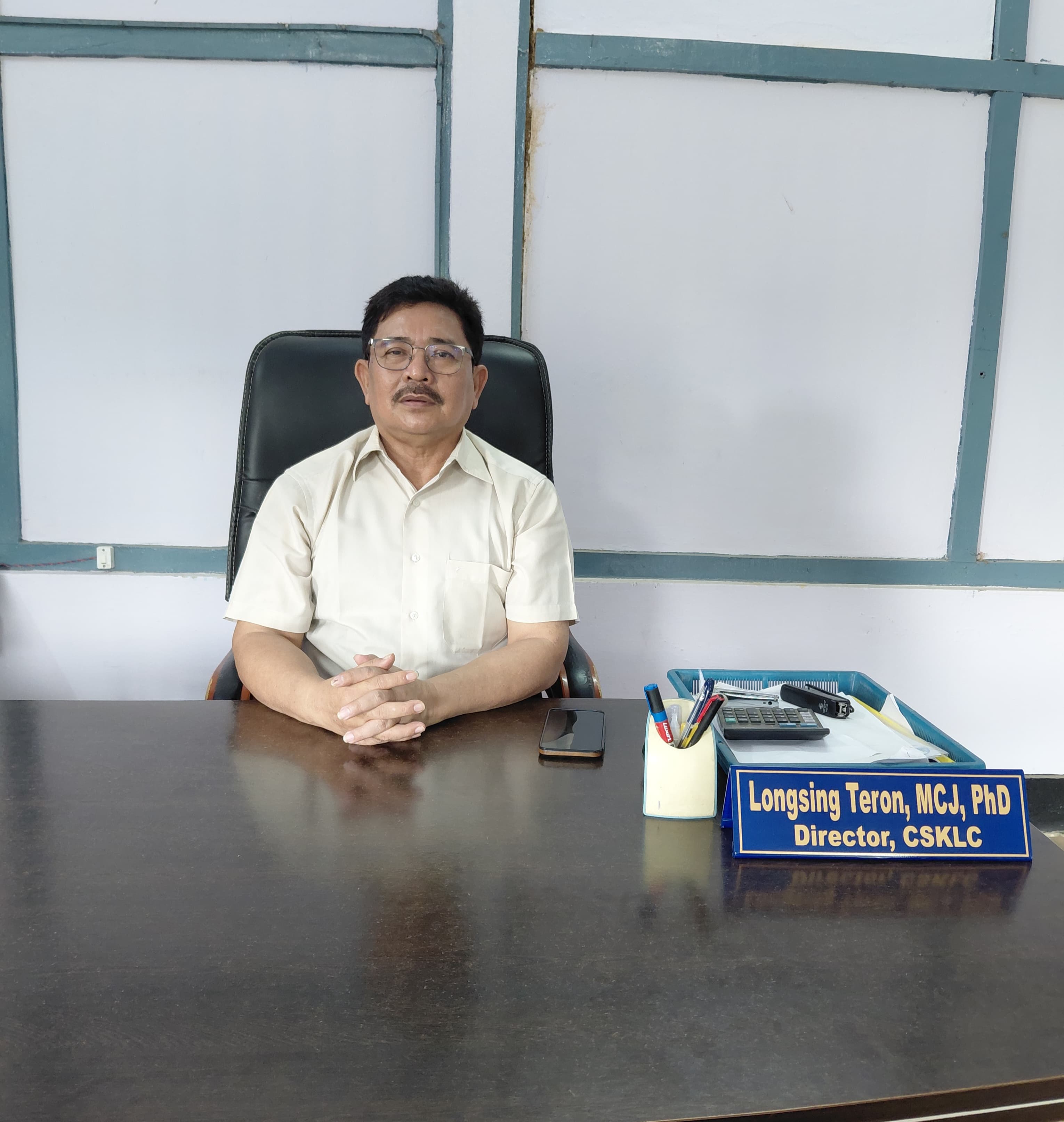
Director
Dr. Longsing Teron
Director, Centre for Studies in Karbi Language and Culture (CSKLC) Connect with the Director
Dr. Longsing Teron holds a PhD in Mass Communication from Assam University, Silchar and a Master's in Mass Communication and Journalism from Gauhati University. He is a distinguished academic, peace mediator, veteran journalist, and cultural champion dedicated to preserving the Karbi heritage and driving socio-educational development in Northeast India. Over a three-decade career, his work has bridged political divides, integrated indigenous languages into mainstream education, and pioneered local media and folk music.
Currently, Dr. Teron serves as the Director of the Centre for Studies in Karbi Language and Culture (CSKLC) under the Karbi Anglong Autonomous Council (KAAC) and as Program Coordinator at the Centre for Studies in Languages, Dibrugarh University, Diphu Centre. It can be termed a mini-campus.
His impactful career spans four main areas:
i. Linguistic & Educational Governance: As the former Chairman of the Karbi Language Development Board, Dr. Teron led the introduction of Karbi as a Modern Indian Language (MIL) at secondary and senior secondary levels. He standardised textbooks, coined contemporary vocabulary, and championed the establishment of Karbi academic departments at Dibrugarh and Assam Universities.
ii.Conflict Resolution & Peace Mediation: A state-recognised mediator, he was the primary negotiator (2009–2011) between the Government of India, the state government, and the armed outfit KLNLF, leading to the peaceful surrender of several cadres. He also served as Chief Convener during the 2005 Karbi-Dimasa conflict, uniting over 21 social organisations to restore peace.
iii. Journalism & Media Leadership: Dr. Teron is the Chief Editor of Thekar, a premier Karbi daily newspaper, and has conducted high-risk investigative field journalism. Locally and nationally, he has held leadership roles as President of the Journalist Federation of Assam (JAFA) and National Secretary of the Association of Small and Medium Newspapers of India (ASMNI) and chief adviser in many journalists’ organisations.
iv. Cultural & Music Production: As the proprietor of LST Enterprise, he pioneered indigenous music by producing over 40 albums that blended traditional Karbi acoustic instruments with modern rhythms. He also wrote and directed cultural documentaries for Doordarshan.
Teron’s contributions have earned him global, national, and state-level recognition. In 2025, he received an International Award in Dubai from the Tribal Business Forum at Global Business Summit-2025. He has also been honoured with the national Bharat Vikas Sangam Award for journalism, the ASMNI National Social Service Award, Bharat Gaurav Award by the India International Friendship Society (IIFS) and prestigious state honours including the Manik Deori Memorial Journalists Award and many more.
Website Development
Designed and Developed by
Rupsong Tisso
B.Tech, Software Engineering
MySQL-php
© All Rights Reserved.